
Coaching in the Age of Isolation
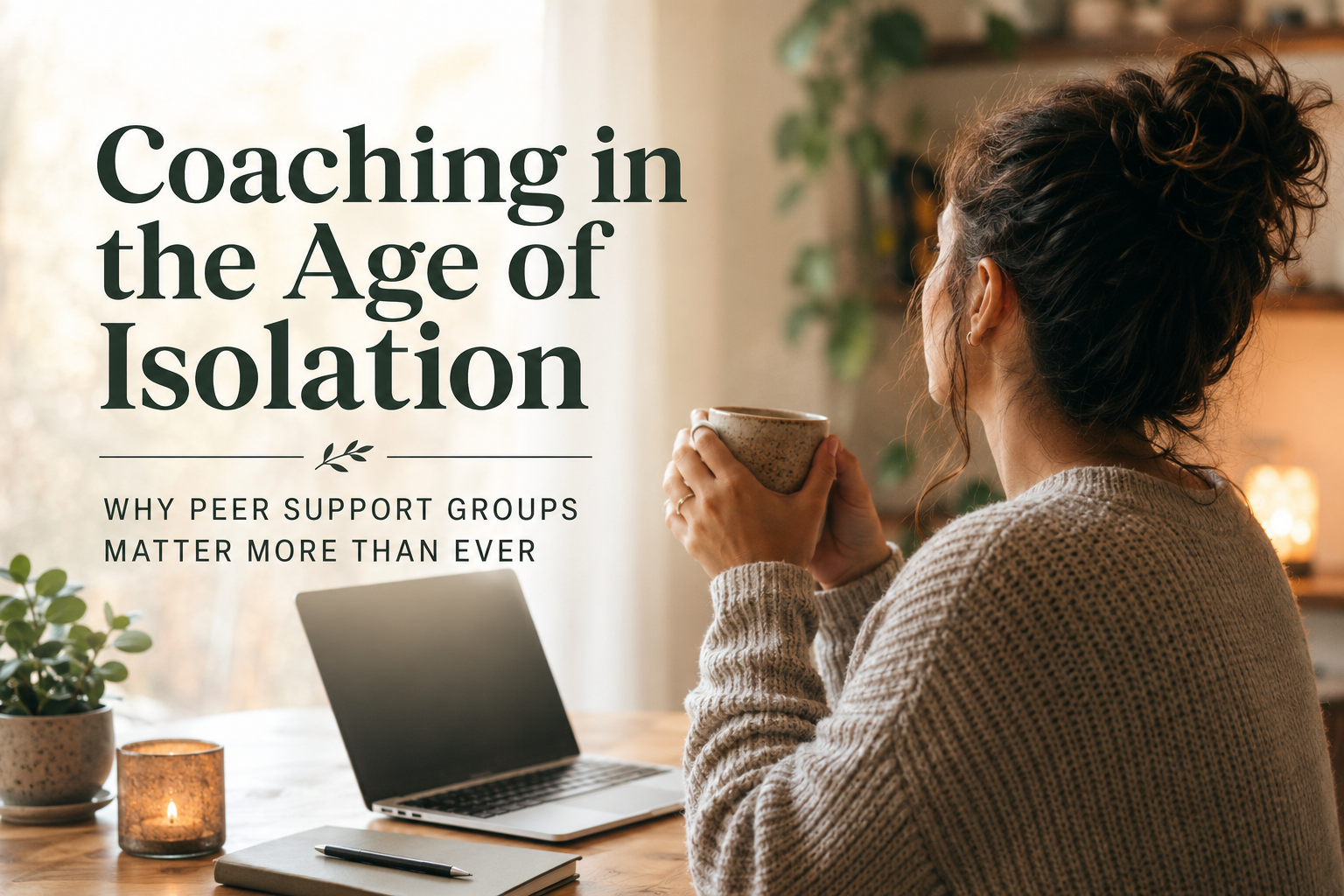
You have four back-to-back Zoom meetings today.
Your Amazon delivery is the only interruption that forces you to stand up, let alone see another person in all their three-dimensional glory.
You would work from the coffee shop, but who needs coffee chit-chat when you can just hop online and feel “connected” without having to shower?
This isn’t a Covid-era tableau. For many, it’s the new normal.
Isolation isn’t only a problem for the work-from-home set.
Despite the ease of online connectivity, or perhaps because of it, many are finding meaningful connection harder to come by. The small interactions that once filled daily life—seeing coworkers in the hallway, volunteering with a community group, dropping by a neighbor’s—are less and less the norm.
Peer support groups can help meet this growing need.
What are peer support groups?
Peer support groups differ from coaching groups, educational groups, and therapy groups in one important way: support flows among the members rather than primarily from the facilitator.
I run groups for people with chronic illness, people navigating career change, and moms who run small businesses, or “momtrepreneurs.” Shared experience is part of what makes the model work.
Another distinction is that peer support groups are facilitated by someone who is a member of the affinity group. In the case of my three groups, I’m a fellow momtrepreneur who has a chronic illness and recently navigated a career transition.
Peer support emphasizes:
shared experience
mutual support
information sharing among members
normalization and destigmatization
vulnerability that develops through trust and safety
In practice, what people gain from these groups is often far more relational than practical.
Connection, connection, connection
“I don’t even know who I am anymore”
“I hate having to pretend I’m someone I’m not.”
“I don’t want to do this alone.”
These are all things I’ve heard from clients—and honestly, they’re all things I’ve thought to myself at one time or another.
Many clients tell me that peer support groups help them reconnect not only with other people, but also with themselves. The time and space to reflect, think, and feel helps participants remember who they are now and who they want to become.
Authenticity is another major theme. Many are balancing work, caregiving, health concerns, or uncertainty about what comes next in their lives. With so much pulling at them, they often lack spaces where they can stop performing the “professional” version or the “family” version of themselves.
But the most meaningful part of these groups, according to participants, is often witnessing the vulnerability of others.
Clients regularly tell me that simply hearing someone else say the thing they thought they were alone in feeling can be profoundly relieving. Recognizing themselves in another person’s experience reduces shame and creates permission to be honest.
In the absence of everyday social connection, many people are carrying loneliness and alienation that remain largely invisible. Peer support groups create spaces where participants can speak openly, feel understood, and realize they are not alone in their experience.
Why these groups matter
Peer support group leaders are fellow-travelers, not experts.
The role is not to provide all the answers, but to create the conditions for people to show up honestly for one another.
Many peer support groups rely on the same relational skills emphasized in coaching:
active listening
curiosity instead of fixing
emotional safety
strengths-based perspectives
The best peer support groups help participants feel heard and respected. They function as intentional communities, with their own agreements and norms.
And participants are not only receiving support but contributing to it. That reciprocity is key to what makes the experience powerful.
Coaching as community building
My clients and prospective clients often share more than goals. They may share a life stage, a challenge, a transition, or a way of moving through the world that leaves them feeling isolated or misunderstood.
Peer support groups help by bringing these people together.
More than guidance or accountability, you may find a space where you feel recognized by others and recognize yourself in others.
In an age where so many opportunities for authentic connection have disappeared, this kind of space may be more valuable than you think.
If you’re interested in learning more about one of my peer support groups, just ask.
