
Navigating Identity Limbo: Strengths-Based Coaching for Career Change
This is part two of a three-part series.
Career change isn’t just a problem to solve—it’s a journey to navigate. My last newsletter introduced the three stages of identity shifts during career transition: grief, limbo, and rebuilding. This newsletter focuses on the discomfort of identity limbo—that in-between state of “not my old self, not yet my new self”—and how insights from positive psychology can help.

Why Strengths Matter in Identity Limbo
Conroy & O’Leary-Kelly describe a liminal phase in career transitions where individuals oscillate between loss and restoration [1]. It may seem like a no-brainer, but strengths-based coaching is especially useful during this stage because it provides continuity in the midst of change. When identity feels unstable, strengths offer an anchor.
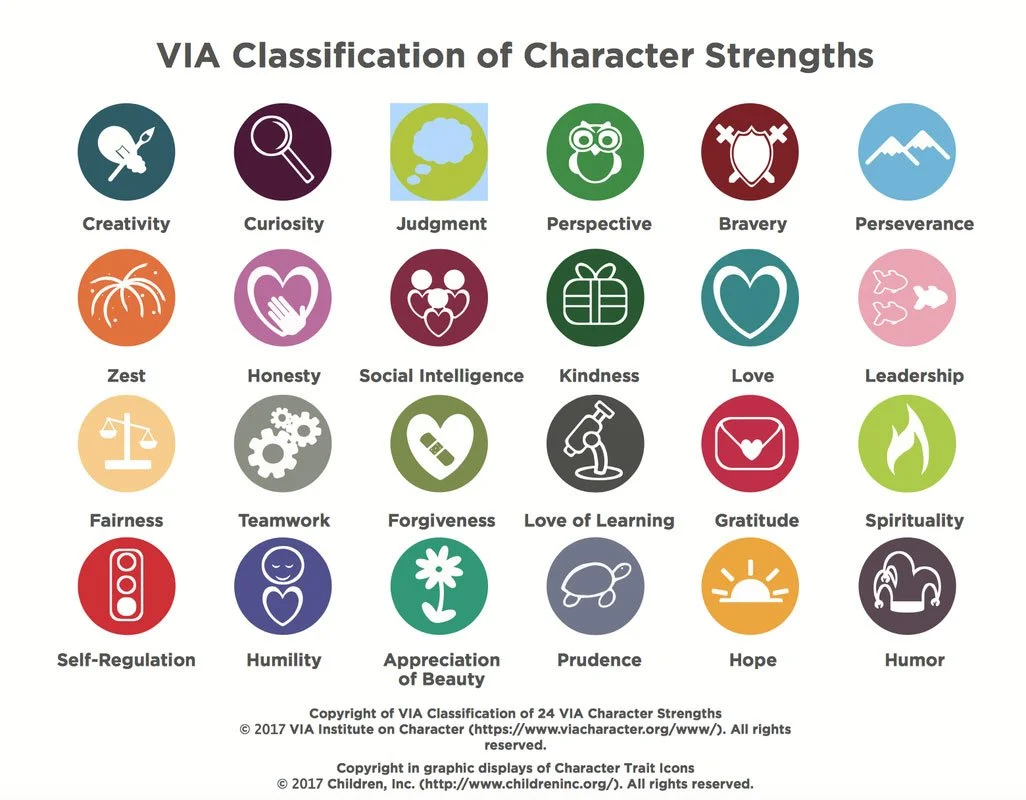
The VIA Character Strengths Survey is a personality test that ranks 24 core character strengths in order from most to least strong (e.g., curiosity, perseverance, kindness, love of learning). Taking the survey allows clients to identify the “positive traits that are essential to a person’s identity” [2]. Seeing these strengths clearly can restore confidence at a time when familiar sources of self-esteem may feel out of reach.
How Strengths Differ from Traditional Career Counseling
Traditional career counseling focuses on:
· Skills—what you can do
· Interests—what you enjoy doing
· Talents—what you’re naturally good at
Character strengths, by contrast, are personal qualities that shape how you do your work. For example, two people may share the same skill set, but one leads with humor and hope, while another leads with prudence and fairness. Same job, different expression of identity.
Research has shown promise for the addition of a strengths-based lens in career counseling. In one study, job seekers who used strengths-based interventions were more likely to become employed than those who used traditional interventions alone [3].
That said, strengths are not designed to be used as a rigid “job-match” formula—your strengths don’t marry you to one career or another. Instead, strengths-based career coaching shifts the guiding question from:
“What job fits my skills and interests?”
to
“What work lets me express who I am at my best?”
Practical Strengths-Based Tools for Identity Limbo
Here are two ways coaches can help you navigate identity limbo using strengths.
1. Working with VIA Strengths
When people express their top strengths daily, they report greater engagement, productivity, and meaning at work [4, 5]. Exploring strengths with a coach can help you develop more awareness, appreciation, and use of your top strengths—whether career change is driven by job loss, illness, burnout, or a desire for greater fulfillment through work.
After completing the VIA Survey, you can brainstorm with your coach on ways to adapt your top strengths to new contexts.
Reflection prompts might include:
What strengths do you want to use more often at work?
How could you redesign your role to better express your strengths?
How might you narrate your career story through the lens of your character strengths?
2. The Peak Experience Exercise
Strengths can also be gleaned through the “peak experience” exercise [6]. First, recall three moments when you were truly “at your best.” As you describe these meaningful experiences, the coach listens for how strengths show up in each. These stories can then guide a coaching conversation about strengths and career.
Reflection prompts might include:
What did you appreciate about how you showed up in that moment?
What does this peak experience tell you about your strengths?
How would you like to bring that learning forward as you consider new career pathways?
Both approaches can help you reconnect with who you are—and who you’re becoming—during identity limbo.
How I Used VIA Strengths During My Own Career Transition
Two of my long-standing top strengths are Love of Learning and Creativity. When I was considering coaching as a new career pathway, I could see how the need for continuing education, working with many different types of people, and using writing as a tool for connection would allow me to express these strengths daily. This helped me make sense of the transition and see continuity across roles.
There are so many ways our strengths can contribute to a given career. I’ve met coaches who lead with honesty, curiosity, bravery, social intelligence, zest, or humor—and it’s clear that each brings something different and valuable to their clients.
If you’re considering a career change and feeling the ambiguity of identity limbo, you can start exploring with me by scheduling a free, 30-minute consultation.
This article was adapted from my workshop, “Guiding Identity During Career Transition,” presented at the University of Pennsylvania’s Career Services on November 5, 2025.
References
[1] Letting Go and Moving On: Work‑Related Identity Loss and Recovery
[2] What’s Missing in Your Career?
[3] Strengths-Based Career Counseling: Overview and Initial Evaluation.
[4] Strengths Use and Work Engagement: A Weekly Diary Study
[6] Coaching Positively: Lessons for Coaches from Positive Psychology
